What the science says...
That humans are causing global warming is the position of the Academies of Science from 19 countries plus many scientific organisations that study climate science. More specifically, 97% of climate scientists actively publishing climate papers endorse the consensus position.
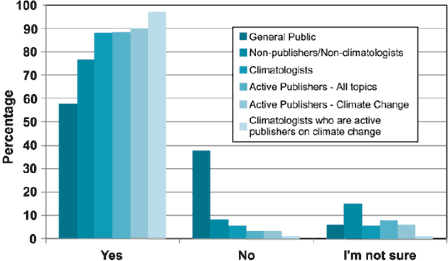
Inevitably, there will be scientists who are skeptical about man-made global warming. A survey of 3146 earth scientists asked the question "Do you think human activity is a significant contributing factor in changing mean global temperatures?" (Doran 2009). More than 90% of participants had Ph.D.s, and 7% had masters degrees. Overall, 82% of the scientists answered yes. However, what is most interesting is response rates compared to the level of expertise in climate science. Of scientists who were non-climatologists and didn't publish research, 77% answered yes. In contrast, 97.5% of climatologists who actively published research on climate change responded yes.
Figure 1: Response to the survey question "Do you think human activity is a significant contributing factor in changing mean global temperatures?" (Doran 2009) General public data come from a 2008 Gallup poll.
As the level of active research and specialization in climate science increases, so does agreement that humans are significantly changing global temperatures. Most striking is the divide between expert climate scientists (97.4%) and the general public (58%). The paper concludes "It seems that the debate on the authenticity of global warming and the role played by human activity is largely nonexistent among those who understand the nuances and scientific basis of long-term climate processes. The challenge, rather, appears to be how to effectively communicate this fact to policy makers and to a public that continues to mistakenly perceive debate among scientists."
Scientific organisations endorsing the consensus
The following scientific organisations endorse the consensus position that "most of the global warming in recent decades can be attributed to human activities":
National Oceanic and Atmospheric Administration
Environmental Protection Agency
NASA's Goddard Institute of Space Studies
American Geophysical Union
American Institute of Physics
National Center for Atmospheric Research
American Meteorological Society
The Royal Society of the UK
Canadian Meteorological and Oceanographic Society
American Association for the Advancement of Science
The Academies of Science from 19 different countries all endorse the consensus. 11 countries have signed a joint statement endorsing the consensus position:
Academia Brasiliera de Ciencias (Brazil)
Royal Society of Canada
Chinese Academy of Sciences
Academie des Sciences (France)
Deutsche Akademie der Naturforscher Leopoldina (Germany)
Indian National Science Academy
Accademia dei Lincei (Italy)
Science Council of Japan
Russian Academy of Sciences
Royal Society (United Kingdom)
National Academy of Sciences (USA) (12 Mar 2009 news release)
A survey of peer reviewed research
It is also worthwhile examining peer reviewed journals - scientists can have their opinions but they need to back it up with empirical evidence and research that survives the peer review process. A survey of all peer reviewed abstracts on the subject "global climate change" published between 1993 and 2003 show that not a single paper rejected the consensus position that global warming is man caused. 75% of the papers agreed with the consensus position while 25% made no comment either way (eg - focused on methods or paleoclimate analysis). More on Naomi Oreskes' survey...
Klaus-Martin Schulte's list of studies rejecting the consensus
That is not to say there are no studies that reject the consensus position. Klaus-Martin Schulte surveyed peer reviewed abstracts from 2004 to February 2007 and claims 32 studies (6%) reject the consensus position. In these cases, it's instructive to read the studies to see whether they actually do refute the consensus and if so, what their arguments are.