Personally I wouldn’t pay for an exploration phone call, think that’s taking the p@ss a bit and could paint the impression the broker is hard up for cash. You can call the big accountancy firms like KPMG and Grant Thornton and talk to their M&A for advice and discuss options before you decide to appoint or not, believe that’s the same for a lot of smaller brokers at the exploration stages.
The point regarding upfront fees v success fees is interesting.
The problem is there are a lot of brokers that promise the earth and deliver FA. Worse with some capital raising brokers they want fees for preparing IMs etc and make a business out of doing that.
I think If I was paying an upfront fee I would want to know what work they were going to do for my money, what connections they have, who they would engage with to get my sale secured.
I would use a broker on the sales side if I could secure two or more buyers. That way the broker could help negotiate a better price, help create an action and deliver value.
On the buying side, I’m not so bothered about the broker unless they have many clients on their books. Guess it depends what your buying, if you are spending a few million quid using one of the big players would probably be to your advantage. If it’s a fish and chip shop for £100k in Dagenham do I really need to buy through a broker, possibly not just good DD via my solicitor and support from my accountant.
Good luck
Apologies for the long post that follows- I'm going to be very open with how WE work, and share our fees etc. Transparency is unusual in our industry, but hopefully, some of you find the following interesting and useful...... hopefully it'll show you the work undertaken by a team that genuinely cares about their clients, and about finding the right outcome!
We would always have a partner level call with anyone interested in M&A who contacts us, if they're too small for us, then we'll sign post them to people we know will do a good job, no matter the size of their business. Every business owner is worth having a natter to- they all have an interesting story even if we aren't for them- but they all deserve looking after as we've all been on the same journey of pain, risk and reward. Besides! Some of our biggest transactions are from people we spoke to 5 years ago, with respect and openness! We sign post about 50% of everyone referred to us, usually because we are just too expensive, or too busy to do a good job. We only take on work where we know we can add value, and deliver excellence.
In terms of fees, we always charge a retainer and a success fees. We typically charge £39k upfront for a full market approach and the cost to us is well over £47k in time and technology (but then we are unusual in that we have no one junior in our team, so our fixed costs are more expensive). We share with potential clients where those costs come from and will shortly be publishing them on our website for the world to see. Our success fees are more nuanced for sale mandates ranging from a flat fee, to a fixed fee with an adjuster if we achieve over a certain target, to a waterfall. The overall fee will often range from 1.5% to 3.5%! Its a big range, but again we'll share with our clients how our board has formed that view on fees. We are rarely the most expensive, and we are almost never the cheapest!
Whats really interesting is your comment that you want to know what work an advisor does- and you absolutely should know- I fundamentally disagree with Clinton that advisors shouldn’t have to share the work they are going to do for their clients if asked- it’s a form of corporate arrogance that we find abhorrent. To be honest we don’t usually get asked so we tell clients anyway…. And promptly win the work- most recently winning a 9-figure European client from under the noses of Rothschild and EY because of it.
So you know what this looks like- We lay out a detailed gantt chart specifically tailored to each individual transaction, it lists exactly what work each member of our team will undertake on client project, the input, output, timeframe, target completion date at every stage and the client deliverables required at every stage. We then have a live client portal where clients can see in real-time what work we have completed for them that day.
When we are in active marketing phase we share live marketing info, as we track and record every call, email and LinkedIn message that we send on behalf of our client- so our clients can see in real-time who we've spoken to and what the conversation was- they can even see in real-time the individual pages that acquirers are looking at of their Information Memorandum! We have no need to share or track partners time with clients- byt the time we are meeting with acquirers our partners will be talking to clients every couple of days at least. During negotiations and due diligence we'll often be talking to clients 4-5 times per day, 7 days per week, 365 days per year (I currently have a client working from his Australian house, so I'll sometimes talk to him at 1 or 2am UK time! that's why we have two partners on each of our client transactions). for 4 months up to completion our clients will talk to us far more often that they talk to their other half!
The most common approach in M&A is not to tell the client anything about the work that is being undertaken except in the very widest terms.
We track our progress against the agreed Gantt chart but we also flex our plan in response to project progress (ie maybe the response is SO strong that we want to flip to a really structured auction progress, with things like DD races- ie whoever can finish Due Diligence first, using the SPA WE provide buys the business..... no buyers like M&A teams when they do this.... clients love it though

)
We will also define, before the client signs up, how we are going to find potential acquirers, where, what they will look like and the outputs they can expect from us. They will also meet the 2 partners that will lead their transaction on a day-to-day basis.
The question on connections is interesting- its now often irrelevant to be honest- as complete change from 15 years ago! We have 15 staff each with at least 15 years of M&A experience, some with 50 years! Its incredibly unusual for us not to have the contact number of a CEO, or a high level relationship with the main PE and trade acquirers across Europe and the US. BUT, with the plethora of specialist M&A databases, the need to have connections is only relevant in very niche specific market transactions (The Byre gives a great example…..in our world, raising funds from big VCs is all about who you know- a recent raise we undertook had offers from Softbank, Index and General Atlantic- and this was pretty much only because we have great relationships with senior staff in those businesses- but that’s fund-raising rather than an exit…..)- we are incredibly well connected, but have found this creates complacency and arrogance- you miss very credible buyers just because you aren't looking for them. The best M&A teams will conduct research on a clean sheet basis, finding acquirers around the world, from companies they don't necessarily know!
The vast majority of our work is referral only- we are referred clients from ex-clients, lawyers, some accountants and the likes of Coutts, Rathbones etc. We are often called in to fix broken transactions... usually, unfortunately, broken by other M&A teams or accountants who perhaps don't have the experience required for large complex transactions. Our industry is unfortunately full of people who would give Swiss Tony a run for his money…… I could write a whole book on how to select an M&A advisor! [for what its worth, I got into M&A, after spending 10 years buying and selling my own businesses and missing out on a 7 figure sum, because my very lovely, friendly and mid-market accountant had no idea how to run an M&A process…..]
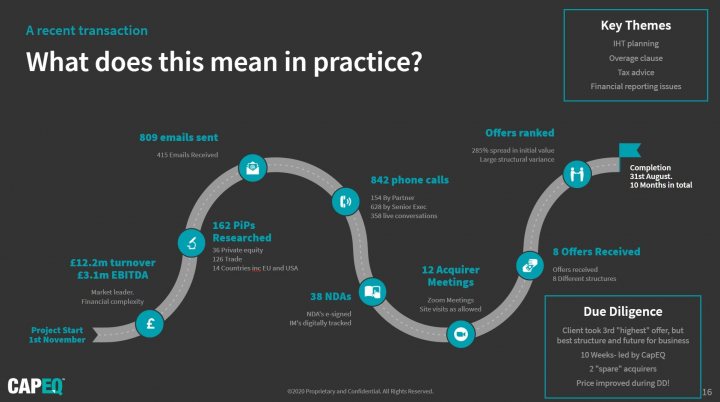
For those that are interested, we mapped the specific work undertaken on a recent completion so you can see the work that goes in. Now this level of detail and rigour is only going to work for a business worth over £5m, and we prefer to work between £10m and £100m as we can add real value at those price points, but it will give you an idea of the work undertaken by larger teams.
This process would look completely different for another project we completed recently in FinTech where we spoke to precisely 5 acquirers. Pips are "potentially interested parties".