Rising energy costs

Waddy

Free Member
Aug 29, 2022
57
12
Anyone on a fixed rate below 34p kwh will stay on their existing rate

Anyone between 34p and 51p will go on the 34p rate

Anyone paying over 52p will get their rate reduced by 17p

Those on a fixed rate over 52p can ask their supplier to move them from the fixed rate to the standard, most suppliers are going to allow this

(Domestic, electric)
I'm on a fix of 34.9p until July 2025, will this stay after the 6 months at 34p or will we have to sort out a new contract in 6 months?

I'd rather just stay on the three year fix at 34.9p than get the tiny reduction for 6 months and then have to get a new, inevitably more expensive, contract in 6 months
 
Upvote 0

Waddy

Free Member
Aug 29, 2022
57
12
Anyone on a fixed rate below 34p kwh will stay on their existing rate

Anyone between 34p and 51p will go on the 34p rate

Anyone paying over 52p will get their rate reduced by 17p

Those on a fixed rate over 52p can ask their supplier to move them from the fixed rate to the standard, most suppliers are going to allow this

(Domestic, electric)
Just noticed you said this was for domestic, any idea what's happening for businesses?
 
Upvote 0

NewTime

Free Member
Aug 4, 2020
132
13
I know I have made a point about it already, but I think people are trying to make changes to their lifestyle and some people just aren't.

Last week I jumped on a bus and what seemed a reasonably fit young man pay £1.20 to go ONE STOP on a bus. Was that one stop a long one? Nope! In fact the next stop was all downhill. Imagine wasting money like that on a daily basis.

MInding my own business in Savers this week. A 250ml bottle of shower gel a woman picks up for £1, next to it is a 750ml for £2.

It drives me insane for no good reason really.

I have signed up for a ZIlch Mastercard. You pay your items in ONE and get an instant reward. Example, just spent £24 in store, got 93p banked on the card.

DO people know about TopCashback? Nothing huge, but something.

I am worried for this nation and i can't imagine what it is like for people who are just getting by right now.
 
Upvote 0

IanSuth

Free Member
Business Listing
Apr 1, 2021
3,443
2
1,499
National
www.simusuite.com
The latest news seems to be that the government will limit the wholesale rate that suppliers pay and this will filter down to the customers.

How are they going to limit the price of an internationally traded commodity? No idea
How will it filter down? No idea

Hopefully, the mini-budget might make things clearer.
I suspect they will do it the least efficient way they can think of

Probably something like just guaranteeing that any excess suppliers pay over the cap they will be recompensed by the govt - thus removing any incentive to negotiate or hedge at all.
 
Upvote 0

IanSuth

Free Member
Business Listing
Apr 1, 2021
3,443
2
1,499
National
www.simusuite.com
Anyone on a fixed rate below 34p kwh will stay on their existing rate

Anyone between 34p and 51p will go on the 34p rate

Anyone paying over 52p will get their rate reduced by 17p

Those on a fixed rate over 52p can ask their supplier to move them from the fixed rate to the standard, most suppliers are going to allow this

(Domestic, electric)
Wow those are still high

My fixed (domestic) deal until Oct 23 with Eon (sainsburys)
Elec 19.8kWh 24p standing charge
Gas 3.96 kWh 26p standing charge
 
Upvote 0

Newchodge

Moderator
  • Business Listing
    Nov 8, 2012
    22,625
    8
    7,939
    Newcastle
    Wow those are still high

    My fixed (domestic) deal until Oct 23 with Eon (sainsburys)
    Elec 19.8kWh 24p standing charge
    Gas 3.96 kWh 26p standing charge
    But the media keep saying that the government has stopped the price increase for domestic customers. They haven't they have reduced the amount of increase due on 1 October, but it is still a substantial increase.
     
    Upvote 0
    I suspect they will do it the least efficient way they can think of

    Probably something like just guaranteeing that any excess suppliers pay over the cap they will be recompensed by the govt - thus removing any incentive to negotiate or hedge at all.

    Kwasi Kwarteng: "The issue with hedging is that it is very risky because, essentially, you are taking a bet or trying to insure yourself against price movements"

     
    Upvote 0

    IanSuth

    Free Member
    Business Listing
    Apr 1, 2021
    3,443
    2
    1,499
    National
    www.simusuite.com
    Kwasi Kwarteng: "The issue with hedging is that it is very risky because, essentially, you are taking a bet or trying to insure yourself against price movements"

    Kwasi Kwarteng: "The issue with hedging is that it is very risky because, essentially, someone else is taking a bet or trying to insure themselves against price movements rather than us doing it with govt (read taxpayers) money for them"
     
    • Like
    Reactions: NickGrogan
    Upvote 0
    Kwasi Kwarteng: "The issue with hedging is that it is very risky because, essentially, someone else is taking a bet or trying to insure themselves against price movements rather than us doing it with govt (read taxpayers) money for them"

    He also refers to "Managing Public Money" as a guide.

    "Depending on its circumstances, purposes and risk profile, a public sector organisation may consider using financial instruments provided by the commercial markets. Among these techniques are foreign currency transactions and various hedging instruments designed to control or limit business risks, for example those arising out of known requirements for specific future purchases of market priced commodities"

     
    Upvote 0
    This could get really expensive.

    The government are fixing the wholesale rate, apparently for every business at 21.1p per kWh for power and 7.5p per kWh for gas.

    THIS ISNT THE PRICE YOU PAY.

    The wholesale element makes up about 30 - 40% of the price of power and about 70% of the price of gas.

    This suggests rates of around 50 - 60p for power and 10p for gas.

    But the government is taking out some of the green levies and possibly messing with the other charges too, so final figures will vary. But they will be higher than the headline 21 and 7.5p

    The other worrying statement is that the goverment – expected to be £211 per MWh for electricity and £75 per MWh - meaning its not set yet?
     
    Last edited:
    Upvote 0

    IanSuth

    Free Member
    Business Listing
    Apr 1, 2021
    3,443
    2
    1,499
    National
    www.simusuite.com
    This could get really expensive.

    The government are fixing the wholesale rate, apparently for every business at 21.1p per kWh for power and 7.5p per kWh for gas.

    THIS ISNT THE PRICE YOU PAY
    As you are the only one here with any real insight

    At a guess what % of the real cost are those capped figures and how big is the UK business energy market

    That should allow us to guess how big REALLY EXPENSIVE is
     
    Upvote 0
    If energy prices are set on a global basis, why are the US and Asia paying less than Europe?
    You have to get the energy to Europe. With power you can't, with gas you need LNG sites and big ships. They cost money, a lot of money.
     
    Upvote 0

    japancool

    Free Member
  • Jul 11, 2013
    9,741
    1
    3,445
    Leeds
    japan-cool.uk
    You have to get the energy to Europe. With power you can't, with gas you need LNG sites and big ships. They cost money, a lot of money.

    They have to do that in Asia too, at least in places like Japan. Dunno what Japan is paying for gas and oil though.

    Even with transport costs, 10 times more seems excessive.
     
    Upvote 0
    They have to do that in Asia too, at least in places like Japan. Dunno what Japan is paying for gas and oil though.

    Even with transport costs, 10 times more seems excessive.
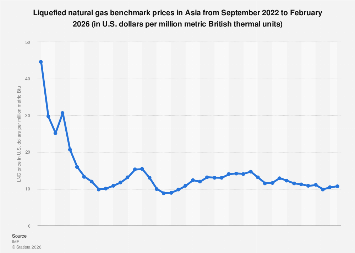
    The global LNG benchmark price amounted to 41.17 U.S. dollars per million metric British thermal units in July 2022. Prices increased since the end of 2021 as a result of supply issues. The largest LNG importers are countries in Asia and the global LNG benchmark is thus a reflection of trading in the Asian market, particularly for Indonesian LNG in Japan. The annual average LNG price in Japan was forecast at 11.4 U.S. dollars per Btu in 2022.


    Most of the LNG is sold on long-term fixed contracts that run for many years. Only about 30% of all LNG is available to trade short term.
     
    Upvote 0

    fisicx

    Moderator
    Sep 12, 2006
    46,650
    8
    15,354
    Aldershot
    www.aerin.co.uk
    I seem to recall the US does a lot of fracking - this drove down their energy prices. But I might be a bit out date here.
     
    Upvote 0

    david@normanst

    Free Member
    Sep 21, 2022
    8
    2
    Hi all,

    Just joined UKBF to see what other businesses are doing in terms of renewing energy contracts before 1 October.

    As stated above, we now know the goverment cap, but still have to get an actual £p per kwh from a supplier.

    We've been quoted 69 pence this week, so say our capped bill could be 28.5 pence per unit plus vat (still a lot more than the 16 pence we were paying before our contract expired).

    Usually we'd lock in a price for say 3 years. Now, we're being told to only do 12 months.

    Don't really want to agree a price for 12 months if the wholesale price recovers in March (when the government assistance prima facie will end) and we end up paying 69 pence a unit for another 9 months (in a recession).

    Other options are:

    1. Agree a 6 month contract and pay a penalty rate as they only consider high winter usage; or
    2. Go onto the deemed rate which will be higher, but still subject to the cap, and see what happens after winter.

    Lost all faith in our utilities broker. Seem to be pushing for a contract because small businesses are holding off until we know the full implications of the goverment cap.

    Your thoughts?

    Cheers,

    D
     
    • Like
    Reactions: ArtieFufkin
    Upvote 0

    roadblock116

    Free Member
    Sep 21, 2022
    7
    1
    Hi all,

    Just joined UKBF to see what other businesses are doing in terms of renewing energy contracts before 1 October.

    As stated above, we now know the goverment cap, but still have to get an actual £p per kwh from a supplier.

    We've been quoted 69 pence this week, so say our capped bill could be 28.5 pence per unit plus vat (still a lot more than the 16 pence we were paying before our contract expired).

    Usually we'd lock in a price for say 3 years. Now, we're being told to only do 12 months.

    Don't really want to agree a price for 12 months if the wholesale price recovers in March (when the government assistance prima facie will end) and we end up paying 69 pence a unit for another 9 months (in a recession).

    Other options are:

    1. Agree a 6 month contract and pay a penalty rate as they only consider high winter usage; or
    2. Go onto the deemed rate which will be higher, but still subject to the cap, and see what happens after winter.

    Lost all faith in our utilities broker. Seem to be pushing for a contract because small businesses are holding off until we know the full implications of the goverment cap.

    Your thoughts?

    Cheers,

    D
    Go for the cheapest right now. Save as much as you can to bankroll you through the hard times.
     
    Upvote 0
    Hi all,

    Just joined UKBF to see what other businesses are doing in terms of renewing energy contracts before 1 October.

    As stated above, we now know the goverment cap, but still have to get an actual £p per kwh from a supplier.

    We've been quoted 69 pence this week, so say our capped bill could be 28.5 pence per unit plus vat (still a lot more than the 16 pence we were paying before our contract expired).

    Usually we'd lock in a price for say 3 years. Now, we're being told to only do 12 months.

    Don't really want to agree a price for 12 months if the wholesale price recovers in March (when the government assistance prima facie will end) and we end up paying 69 pence a unit for another 9 months (in a recession).

    Other options are:

    1. Agree a 6 month contract and pay a penalty rate as they only consider high winter usage; or
    2. Go onto the deemed rate which will be higher, but still subject to the cap, and see what happens after winter.

    Lost all faith in our utilities broker. Seem to be pushing for a contract because small businesses are holding off until we know the full implications of the goverment cap.

    Your thoughts?

    Cheers,

    D
    Seems to be some confusion here.

    If you've been quoted 69p for 12 months, then for the six months from October to April you'll pay the reduced rate, and then you'll pay the full rate from April until the end of the contract. I.e. Six Months.

    The reduced rate will be 21.1p for the wholesale element, plus the other costs. Typically wholesale element is around 35% of the total cost, so on this basis, expect the discounted rate to be in the 60p range.

    IF the government reduce or remove some of the other costs, this will be lower, but there is no clarity on that yet.

    Looking at the options you've given.

    1) agree a six month contract, you would pay the "reduced" rate for the full six months, regardless of what price you agree. So no penalty. Most suppliers dont offer 6 month contracts, a few due.
    2) Go on deemed rate. The deemed rate is not capped in the same way, you can recieve a discount on the wholesale element of the deemed rate, but that discount is limited and means you will pay more for deemed rates. Less than it would have been, more than a "capped" contract.

    If you want to talk about your options in detail, I'm happy to discuss.
     
    Upvote 0

    japancool

    Free Member
  • Jul 11, 2013
    9,741
    1
    3,445
    Leeds
    japan-cool.uk
    I think whatever the government can do, it's still going to be an unbearable increase. What I would be interested in is the government considering permitting customers to break their contract early if the wholesale rate drops (not that it will).

    It's dropped from its peak about 3 weeks ago.

    I'm more interested to know how the Government is going to fund any help they give, because right now, it doesn't look like "jam tomorrow", but "Marmite tomorrow" (other brands of disgusting yeast spread are available).
     
    • Like
    Reactions: david@normanst
    Upvote 0

    Waddy

    Free Member
    Aug 29, 2022
    57
    12
    The reduced rate will be 21.1p for the wholesale element, plus the other costs. Typically wholesale element is around 35% of the total cost, so on this basis, expect the discounted rate to be in the 60p range.
    That 35% figure, is it based on current prices?

    Wholesale prices aren't 'typical' at the moment, so surely they are making up a much higher percentage of the overall cost.
     
    Upvote 0

    david@normanst

    Free Member
    Sep 21, 2022
    8
    2
    Absolutley right. Even when considering the 'usual wholesale costs' I have been told that wholesale costs represents anywhere from 30% to 45%. So now, should we assume it's 45% plus? Ultimately, we will all need to know this so we can figure out what we will actually pay for cashflow purposes. The gov.uk guidance refers to the government publishing this wholesale price data as a reference point but it's not available yet. Daft thing is, this infromation probably won't be known for a while and a lot of us (me included) will be entering into contracts in the next few days and weeks for x price which is not the price you will pay.
     
    Upvote 0
    The government haven't issued the reference price data yet, they also haven't issued the guidance and toolkits on what is, and what is not included yet.

    Ultimately no one knows what the price of power and gas will be on the 1st of October yet.

    There are also questions about maximum support levels. This seems to only apply to out-of-contract rates, but as always the devil is in the detail, and we have no details.

    35% is on the pessimistic side, but given the way the markets have been over the last 12 months being pessimistic has paid off.

    If the rates that are billed are in the 30p range, so much the better, but I wouldn't recommend anyone budgeting for that level, until we see the first confirmations and invoices issued.
     
    • Like
    Reactions: david@normanst
    Upvote 0

    BobzYourUncle

    Free Member
    Aug 28, 2022
    54
    44
    So i used a business energy online calculator that gives a very rough idea of the amounts I will save on my gas bill after the government cap on the wholesale element part.. it works out at 7% reduction.. which frankly isnt going to be of much help on a bill that's increased by 300%. The calculator doesnt take into account climate levy or VAT. I think the government has kinda over hyped the help they are giving as something substantial and meaningful. in reality I can't see how those with even greater increases are going to see any differnece or improvement to their dire predicament. Most likely cost of stock will go up further because of the falling pound. Urghhh more turbulence.
     
    Upvote 0

    Latest Articles