
You are using an out of date browser. It may not display this or other websites correctly.
You should upgrade or use an alternative browser.
You should upgrade or use an alternative browser.
Website Colours
- Thread starter MarcusUK21
- Start date
I wondered what people’s views were about the most suitable colour themes to use for an online store selling gifts and Home products. Is there some colours to avoid like red?
I would, personally, avoid red. But it is a bit subjective.
Avoid colours that make it harder to use for people with reduced visibility, including colour blindness.
Upvote
0

Colours make a massive difference, testing is harder unless you have a high volume of traffic.
We had a store a few years back that had a high(ish) volume of traffic and orders and split tested the colour of the buttons.
It increased add to carts by about 1%, which doesn't sound huge but added a significant increase to overall sales.
The theory is red stops people, green encourages people, i.e. traffic lights and the fact red is programme to make people stop.
We have a client who's colour base is red/black and they have no problem with conversions.
As Paul says focus on usability and accessibility
Find colours that provide maximum contrast, including enough contrast between content and the background, so that text and non-decorative images are legible for anyone with low vision or colour deficiencies.
Clean is often best, and less can be more.
Lots on Google, for example
https://neilpatel.com/blog/psychology-of-color-and-conversions/
https://www.crazyegg.com/blog/website-color-palettes/
We had a store a few years back that had a high(ish) volume of traffic and orders and split tested the colour of the buttons.
It increased add to carts by about 1%, which doesn't sound huge but added a significant increase to overall sales.
The theory is red stops people, green encourages people, i.e. traffic lights and the fact red is programme to make people stop.
We have a client who's colour base is red/black and they have no problem with conversions.
As Paul says focus on usability and accessibility
Find colours that provide maximum contrast, including enough contrast between content and the background, so that text and non-decorative images are legible for anyone with low vision or colour deficiencies.
Clean is often best, and less can be more.
Lots on Google, for example
https://neilpatel.com/blog/psychology-of-color-and-conversions/
https://www.crazyegg.com/blog/website-color-palettes/
Upvote
0


I had a client who changes his colours and imagery to suit the seasons. He sells homeware and his customers like it (gets lots of chatter on FB and instargam).
There is no right colour/palette. You find the most suitable for your website by testing. That being said, right now muted greys seem to be popular. This may change next year when the big stores get their new collections in.
There is no right colour/palette. You find the most suitable for your website by testing. That being said, right now muted greys seem to be popular. This may change next year when the big stores get their new collections in.
Upvote
0
- Original Poster
- #5
Muted
green sounds good and great idea to change with seasons too. ThamksI had a client who changes his colours and imagery to suit the seasons. He sells homeware and his customers like it (gets lots of chatter on FB and instargam).
There is no right colour/palette. You find the most suitable for your website by testing. That being said, right now muted greys seem to be popular. This may change next year when the big stores get their new collections in.
Upvote
0

I mean colours should be part of a larger design and brand ethos. In a previous job as an in-house designer, my boss wanted to be seen as both a high-end brand, but also wanted to cover the marketing materials (mainly brochures) in Argos-style red callouts for discounts.
We sat down with him and looked at some low-end discount-heavy branding and some high-end quality-focused branding (Think Waitrose vs Farm Foods) and showed how the colours, fonts, photos etc were consistently one look or another.
Other people's suggestion of testing is sensible, though. There is a Google service that allows you to A/B test colour changes, etc. in real time. Great for that sort of thing. You can find some details on that, here:
https://support.google.com/optimize/answer/6211930?hl=en
We sat down with him and looked at some low-end discount-heavy branding and some high-end quality-focused branding (Think Waitrose vs Farm Foods) and showed how the colours, fonts, photos etc were consistently one look or another.
Other people's suggestion of testing is sensible, though. There is a Google service that allows you to A/B test colour changes, etc. in real time. Great for that sort of thing. You can find some details on that, here:
https://support.google.com/optimize/answer/6211930?hl=en
Upvote
0
Works for Waitrose.Muted green sounds good and great idea to change with seasons too. Thamks
Some palette suggestions: https://www.colourlovers.com/palettes/search?query=green
Depending on your target but this could work: https://www.colourlovers.com/palette/919419/An_Old_Friend The palette lives in the background to help push the product images to the fore.
Knew one lady who arranged here category listings so the product colours flowed. For example:

Upvote
0





It matters a lot. Maybe on the exact shade of a colour but the colour choice can make a huge difference to sales.I don't think the actual hue matter
For example, try selling hardcore goth products on pink themed site.
Upvote
0

Colours are trending. Now it can be blue, green, grey. Then it will be red, orange, yellow.
Also choosing colors depends on design style (Neumorphism, flat design, etc.). As a user I prefer sites which don't use colours (just logo, may ne some UI elements or CTA). But there can be many cutural, local, niche factors.
I don't know how people test the website colour schema. Seems it'd be better to ask your visitors (I think many of them won't recall a colour scheme which you use now).
Also choosing colors depends on design style (Neumorphism, flat design, etc.). As a user I prefer sites which don't use colours (just logo, may ne some UI elements or CTA). But there can be many cutural, local, niche factors.
I don't know how people test the website colour schema. Seems it'd be better to ask your visitors (I think many of them won't recall a colour scheme which you use now).
Upvote
0
I know that, but it doesn't seem valid.You do split testing with alternate stylesheets and monitor user actions.
Upvote
0
Don't know what you mean. You look at the results and if you get considerably more conversions using a red button than you do a blue you know which one to use. You can do the same with font size, imagery, positions and anything else. By testing layouts I got a PPC landing page for a client up from 20% conversion to almost 60%.I know that, but it doesn't seem valid.
Upvote
0
Thank you for that @fisicxDon't know what you mean. You look at the results and if you get considerably more conversions using a red button than you do a blue you know which one to use. You can do the same with font size, imagery, positions and anything else. By testing layouts I got a PPC landing page for a client up from 20% conversion to almost 60%.
As a marketer I also did A/B testing for the landing pages. The split-testing is not perfect way to improve conversion rate even if there is a good experience. I prefer to use other methods but they have their downside as well.
Anyway, there is nothing wrong to use split-testing if it works.
Upvote
0
What other methods?I prefer to use other methods but they have their downside as well.
The trick with split testing is to only focus on one change. For example to location or colour of a CTA. But not both (you won’t know if it’s the colour or location that affected the outcome).
Upvote
0
These methods are surveys (including qualitative marketing research), polls, UX research. In many cases it is enough to follow common practices and make CTAs visibale and clear for the visitors.What other methods?
Upvote
0
People lie or just guess. With split testing you are seeing how people use a site. Combine with heatmapping and click trails and you really good data.These methods are surveys (including qualitative marketing research), polls, UX research
Common practice is often wrong. Following what everyone else does is not as good as testing. There has been loads of research on how to develop a CTA. And there are dozens of different answers. You won't know which one is right for you until you test.In many cases it is enough to follow common practices and make CTAs visibale and clear for the visitors.
Lets say you use a standard CTA and are converting at 10% with each conversion earning you £100. But maybe if you tested and changed the CTA you could double that number. Following common practice could be losing you money. Don't assume - test!
Upvote
0
People lie or just guess.
That's true. But if you provide your research in a controlled environment, you can get correct data. To start split-test you should construct a viable hypothesis. So, you need the data or the experience.
Also, split-test means that you need a relevant traffic. But what is about if you have just created a landing page?
In many cases you have random traffic on a landing page so it means data can't be relevant. But what can I do, if my page attract 10-20 visitors per day?
Many people must use common themes, layouts, so they use common practices. I read many success stories in which marketers changed the colour of button and got 100 per cent increase in conversions, but I rarely saw that in real life.
Also, many people don't know common conversion rate optimization (CRO) practices. This is why they did mistakes and lose their money instead of invest that in professional services.
But, if many people use similar layouts for their sites, it'd be beter to invest in marketing messages that waste time and money in testing colours.
That's true. But if you provide your research in a controlled environment, you can get correct data. To start split-test you should construct a viable hypothesis. So, you need the data or the experience.
Also, split-test means that you need a relevant traffic. But what is about if you have just created a landing page?
In many cases you have random traffic on a landing page so it means data can't be relevant. But what can I do, if my page attract 10-20 visitors per day?
Many people must use common themes, layouts, so they use common practices. I read many success stories in which marketers changed the colour of button and got 100 per cent increase in conversions, but I rarely saw that in real life.
Also, many people don't know common conversion rate optimization (CRO) practices. This is why they did mistakes and lose their money instead of invest that in professional services.
But, if many people use similar layouts for their sites, it'd be beter to invest in marketing messages that waste time and money in testing colours.
Last edited:
Upvote
0
I think this article explains the advantages and disadvantages of A/B testing better than me, also it does that in proper English https://www.nngroup.com/articles/putting-ab-testing-in-its-place/
Upvote
0
Not sure a 16 year old report can be used as guideline today. A later article tells a different story:
https://www.nngroup.com/articles/ab-testing-and-ux-research/
And he also says you need to test colours:
https://www.nngroup.com/articles/color-enhance-design/
https://www.nngroup.com/articles/ab-testing-and-ux-research/
And he also says you need to test colours:
https://www.nngroup.com/articles/color-enhance-design/
Upvote
0
Not sure a 16 year old report can be used as guideline today. A later article tells a different story:
https://www.nngroup.com/articles/ab-testing-and-ux-research/
And he also says you need to test colours:
https://www.nngroup.com/articles/color-enhance-design/
Thank you for that. It seems interesting for me. Now I know how to spend my weekend

Upvote
0
Everything is about testing. Never assume anything. This is why a Website Review on UKBF can be so useful. You might think your site is the bees knees but a stranger will point out things you often overlook through familiarity. Colours is just one those things. Younger people with good eyesight may be able to easily read white on blue (or whatever) but someone older who's eyes ain't so good anymore will struggle and may give up.
Upvote
0
Um, they wrote about usability testing to test colours scheme. Our agency designers use that.Thank you for that. It seems interesting for me. Now I know how to spend my weekend
Upvote
0
Everything is about testing. Never assume anything. This is why a Website Review on UKBF can be so useful. You might think your site is the bees knees but a stranger will point out things you often overlook through familiarity. Colours is just one those things. Younger people with good eyesight may be able to easily read white on blue (or whatever) but someone older who's eyes ain't so good anymore will struggle and may give up.
I can't disagree with you there.
Upvote
0
In that case they need a kick up the backside: https://wave.webaim.org/ Try testing your own site.Um, they wrote about usability testing to test colours scheme. Our agency designers use that.
Upvote
0


I'm reading this at the moment and it talks about colour a lot: https://www.amazon.co.uk/Webs-Influence-Psychology-Online-Persuasion/dp/1292134607/I wondered what people’s views were about the most suitable colour themes to use for an online store selling gifts and Home products. Is there some colours to avoid like red?
Paul.
Upvote
0



I wondered what people’s views were about the most suitable colour themes to use for an online store selling gifts and Home products. Is there some colours to avoid like red?
I'm replying to this from the perspective of a marketeer, not a designer. Although I work alongside designers.
There are two ways to approach this. If you want to do it properly, the decisions on colour shouldn't really be led by your website or niche, they should be led by your brand.
Approaching your colour choices from the perspective of your brand will lead to a far more consistent sense of identity to your website visitors, than simply choosing colours because you feel they fit a particular range of products.
In an ideal world, a designer would be starting our by choosing a colour palette, and potentially complementary palette, and from this, a logo, typography choices and perhaps a brand guideline could be developed. The end result means that when the website designer is creating your site design, they can think about which colours to use based on the brand.
Obviously having a brand and brand guideline created isn't always viable or on budget, but still, the choice of colour should not come from the niche or product alone.
Your best approach if handling this alone would be to think of a range of colours which complement each other. You can use online tools for this such as;
https://coolors.co/
Write yourself a small mini-brand guideline. Come up with a range of 5 or 6 main colours, and how/when you will use them. Seeing a range of colours often helps to identify which colours work well for you, rather than a single colour on its own. for example, with the below palette you can see how the red might look alongside some other colours;
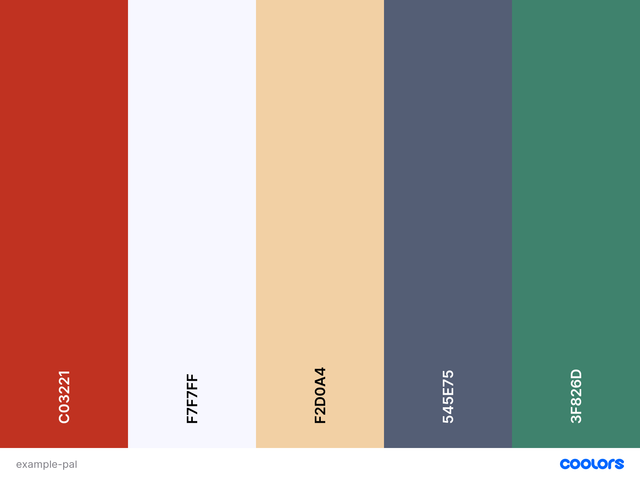
When it comes to colour choices and websites, having a consistent approach is always more important than the actual colour choice, and will have far more impact on building trust and a sense of brand with your website visitors.
Upvote
0
Latest Articles
-
 Should you crowdfund? A framework for UK founders in 2026Three articles into a series on what crowdfunding actually costs, the...
- Ozzy
- Updated:
-
The polls, the reframing, and the billion dollarsHow three letters from the early years of Star Citizen's development...
- Ozzy
- Updated:
-
The values trap: what the Punks actually ownedWhy BrewDog's Equity for Punks investors were structurally locked out...
- Ozzy
- Updated:
-
When belief is the business modelWhat BrewDog's collapse and Star Citizen's billion-dollar climb are...
- Ozzy
- Updated:
-
AI, Virtual Influencers and the Copyright Minefield: What Entrepreneurs Need to KnowI'll be upfront: this article was written with the assistance of an AI...
- Ozzy
- Updated: