choosing a new career...

Panky123

Free Member
Feb 10, 2013
75
5
So i am currently undergoing resettlement for being medically discharged from the army, so i now have the headache of finding a new career and i am completely stumped!
I have no real qualifications outside the army, and my experience is from 9 years in the infantry.
I like the idea of a well paid office job, as i am based in London i walk around central London alot and i see so many people walking round suited and booted and i always like to think to myself 'what do all these people even do?'
how do people get into these corporate firms? and how do i go about aiming off on which courses i should go towards. The army offers me quite a nice package on helping me pay for courses etc. but i have no idea what i want to even do lol

Now i know you guys cant tell me what to do with the fact you dont even know me or my personality but i am hoping that with some sort of conversation with like minded people that might know what im talking about maybe offering up some ideas on what i can do, might actually jog my mind and imagination on what i want to do with the rest of my life :p
 

Mr D

Free Member
Feb 12, 2017
28,924
3,630
Stirling
Qualifications and experience count. Well paid office job in central London you may have a bit of competition from those who are lower paid than that in the area.

Sadly a lot of job applications require a degree - could be in basket weaving for all the use it is in a job so long as you have a degree.
Have met lawyers and accountants with history degrees. Have met chief executive of a factory plant with zero O levels.
9 years I'm guessing you spent a good chunk of that with leadership experience? That can count in some jobs with just a bit of management experience added on top (OK, a lot of management experience).
Professional or management tends to be the higher paid jobs - not always but often enough.
 
Upvote 0

Panky123

Free Member
Feb 10, 2013
75
5
i do intend to go to university, i assumed it would be better doing a degree in the aspect of the job i intend to go to though.
However even upon completion of uni, where do you even find a job? Imean there is literally job roles and companies that i wouldnt even dream of searching lol
 
Upvote 0

Mr D

Free Member
Feb 12, 2017
28,924
3,630
Stirling
i do intend to go to university, i assumed it would be better doing a degree in the aspect of the job i intend to go to though.
However even upon completion of uni, where do you even find a job? Imean there is literally job roles and companies that i wouldnt even dream of searching lol

University career service tends to have some jobs, there are also tons in the various papers, online, through contacts etc. And good old fashioned job agencies - my wife tends to get jobs through job agencies as a temp then transition to employed by the company.

There are also professional bodies / trade mags for particular types of job that will have adverts.

Finding job adverts usually isn't the hard part. Getting an interview is.
Can help to work low level / not so low level jobs in that general field you want to go into during university holidays. Starting to apply for permanent jobs with a summer or two of experience stands out more than no experience in that field even if not directly related to the particular job being applied for.
 
Upvote 0

MartinCivil

Free Member
Sep 14, 2017
150
34
With the cost of university (although perhaps you might have this covered) and the time it takes, will it be worthwhile? People will be falling over one another to get into these graduate schemes with top London firms, and from what I have experienced, for next to no money to start with.

My brother in law is at the stage of deciding whether to go to university or not, and my advice to him is to make a long term plan. Decide what you want to do, and then think about whether an expensive degree is necessary. We have guys working for us that earn in the region of £50k a year that don't have qualifications, they just work hard, having laboured for a good while and learnt their trade whilst working.

I would put a good bit of thought into whether an office job will suit you, if you have been in the military for a good while, it will be a very different dynamic!
 
Upvote 0

Panky123

Free Member
Feb 10, 2013
75
5
The army actually pay for my degree if I wanted to go for it so funding isn't the real issue, but as you say 3 years to finish the degree takes me to 30 then I'd be starting right at the bottom of the pile somewhere.
I have been told a lot that a degree means nothing now days but the jobs I have researched they all require graduate level education which tells me I won't get a decent paying job without the degree.

I agree coming from the military and moving towards a suit and tie sounds quite strange but with my back being te reason of discharge I won't be able to do these construction jobs or full on physical jobs, whereas the office jobs I have been looking into like sales or something, everywhere has said that this type of career is fast paced and constant which I like the sound of...

A big drama of mine is the old saying it's not what you know, it's who you know which causes me drama because I dot actually know anyone that goes to work in a suit lol
I am quite interested in the stock market so maybe doing a degree in economics, business or marketing may give me the edge along with life experience to get a decent job maybe?
 
Upvote 0

BTON Agency

Free Member
Aug 19, 2014
143
24
Sussex
Best of luck on the new role, finance is good and helps you become self-employed. Maybe get the diploma for pensions and fund management.

This may sound nasty (its not meant to be). I think your biggest skill to achieve would be relationship building.

I know, met, worked with a fair few from the forces over the years. Almost all of them have struggled in realising its relationships that get you ahead in the private sector just as much as skills.

A lot tend to alienate themselves from colleagues once they have a role and then they struggle to fit in.

After 9 years it will be an adjustment but sure you can do it :)
 
Upvote 0

Panky123

Free Member
Feb 10, 2013
75
5
ah i know networking is a massive deal in getting a decent job, thats another thing i am actually trying to figure out how to do tbh lol its easy to chat with guys in the army because we live with each other every day lol
i am actually attending some career fairs soon but as for networking with others, i have no idea how to do it tbh lol
as for building relationships after i am in a company i think i shouldn't do too bad as i am quite a confident and outgoing person, just chat to anyone lol
 
Upvote 0
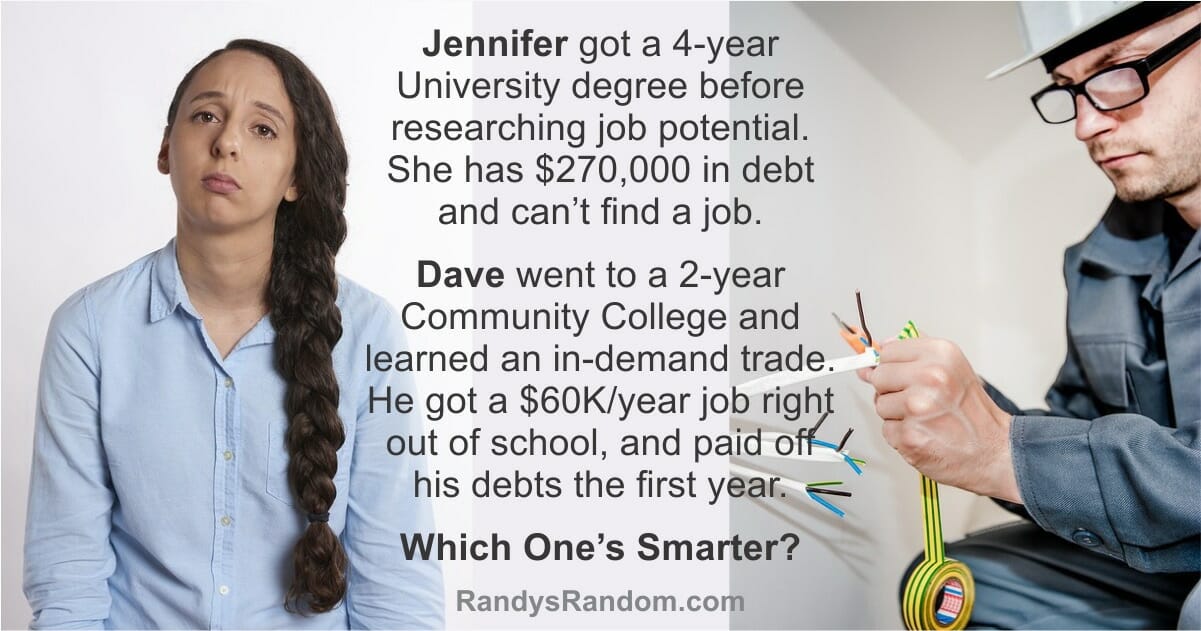
learn-a-trade.jpg


;)
 
Upvote 0
So, from one ex-squaddie to another (albeit, some 40 years older!) -
  • Not all degrees and degree courses are equal. Media studies or golf-course management at some provincial ex-poly is worse than worthless*. Economics at the LSE or Cambridge is golden.
  • Vocational degrees are best avoided! A vocational degree course is only worth anything at all, if it is one of the very select few that the industry of your choice looks to for its graduates. Film at the NFTS or the London Film School is OK, all the others are worse than worthless*. Music Tech at Surrey Tonmeister is golden, all the other Music Technology courses are worse then worthless*. The down-side is, these good courses are unbelievably hard to get on to.
  • You will never get anywhere with a bad back. Lose the bad back. Hang upside-down from the ceiling, use traction, whatever, but nobody will employ someone with a bad back, as it is the malingerer's favourite illness! From here-on-in, you do not have a bad back!
  • You MUST have a marketable skill, whatever you decide to do. Everything you learned in the Army is worthless. There is not much of a market in Civvie-Street for knowing what to do in the case of an ambush, or zig-zag, down, crawl, sights-adjust, fire when being shot at. The I.A. for what to do when a GPMG jams, is just not a marketable skill. An area manager at Aldi needs to find the keys to his complementary Audi A6, he does not need to find his sheet of Q-codes or know how to use a field radio - he has a company smartphone.
  • Boring industries pay well and are seldom boring. Retail, transport, food manufacturing, stuff like that is more interesting than windswept and groovy jobs like film, TV and music. More importantly, boring industries provide you with opportunities for advancement; a cameraman or sound engineer starts his/her career as a cameraman or sound engineer and dies as a cameraman or sound engineer.
  • Aim high. That means a 2:1 in a proper subject from a good university, alongside a minimum of 240 UCAS points (or 150 points for Scottish Highers) from your top three A-levels or Scottish Highers, excluding general studies, to show that you have ability and a strong work ethic. That will get you onto those graduate trainee programmes that start with £40k and rise to £70k after four or five years.
*Worse than worthless - What the Germans call 'Armutszeugnis' and that translates roughly as a certificate of poverty. Something to keep quiet about! A second-rate degree in a second-rate subject from a second-rate university is far worse than no degree at all!

P.S. If the Army is paying for it, take it! Don't think twice! And 30, combined with nine years in the Army (rising to the dizzy heights of Acting Lance Private, 3rd Class!) plus the ability to take your butt to college and get a degree, is far from 'too old' and any pile of CVs would have your CV in the 'To be interviewed!' pile.
 
Upvote 0

Mr D

Free Member
Feb 12, 2017
28,924
3,630
Stirling
Yes golf course management is pretty useless except when it leads to a job managing a golf course. We have what? 3 or 4 golf courses in the UK? And a new one built in the 90s?
Some courses are specialised though skills can be used elsewhere.

It does help a lot if you are interested in the course content. You will be the one spending many hours reading about it in great detail.
 
Upvote 0

WHARTY

Free Member
Nov 18, 2009
941
133
Its not an office job but a company called Hoyer are always on the lookout for ex military. Its essentially driving articulated petrol tankers delivering fuel to petrol stations.

The drivers in the north west earn around 45-50k per year and i can only imagine its more in the London area.

This page is dedicated by Hoyer to ex military. http://www.hoyer.uk.com/careers/careers-at-hoyer/ex-military/

I know lots of drivers who got their licences in the military so you would be in very good company.

It seems they are looking for drivers down south too!
 
  • Like
Reactions: Panky123
Upvote 0

JamieN

Free Member
Sep 23, 2017
2
1
As a general rule of thumb you should avoid studying anything outside the STEM(Science, Technology, Engineering, and Math) degrees. Sure there are a handful of degrees outside of these categories that offer a good return but they are few and far between. Even though you're not paying for your studies you are putting the time in so you want to make sure you get a return on that time investment.

I would highly recommend studying an engineering field if you think you can handle the analytical side of it and you're even remotely interested in it.

Individuals with engineering degrees are highly valued in most industries even if the engineering degree isn't applicable and they're paid well.

If engineering doesn't interest you or you don't want to do it for whatever reason then I'd lean to something in technology or medicine.

For technology anything with data is fun and interesting. Security is huge right now and growing rapidly so any degree or certification related to IT Security would be something to consider as well.
 
  • Like
Reactions: Panky123
Upvote 0

Mr D

Free Member
Feb 12, 2017
28,924
3,630
Stirling
Yes STEM is useful within fields requiring STEM. Not so much useful if you want to do something outside STEM.

Or could end up like that graduate a couple of years back who ended up volunteering in a pen museum with a Geology degree. What she ended up wanting to do and what others thought her qualification taught her was rather different.
 
Upvote 0

JamieN

Free Member
Sep 23, 2017
2
1
Yes STEM is useful within fields requiring STEM. Not so much useful if you want to do something outside STEM.

Or could end up like that graduate a couple of years back who ended up volunteering in a pen museum with a Geology degree. What she ended up wanting to do and what others thought her qualification taught her was rather different.

I disagree. The Engineering and MBA combination for example is the most common education stack for fortune 500 CEOs.

There is huge value in having an analytical undergraduate degree regardless of what field you end up in if you wish to grow into a senior role.
 
Upvote 0
I have an engineering degree. I started as an apprentice and carried on the education side whilst working as an engineer full time. The degree is useful however, the employers (before I became self employed) were more interested in my experience, most of them I didn't even mention the degree to.
 
  • Like
Reactions: The Byre
Upvote 0

Mr D

Free Member
Feb 12, 2017
28,924
3,630
Stirling
Not everyone wants to be a fortune 500 CEO and there's what? 500 positions of which not many vacancies a year?

Getting there requires the right projects / seniority / skillset / abilities / kissing butt etc.
Have met plenty of engineers, the ones who aspire to office / paperwork / meetings / people involvement work are a small percentage of those who aspire to do what they like doing and got the job for.

Have met just the one engineer with MBA. He worked as a teacher in a senior school teaching maths - a job he enjoyed and retired with.
 
Upvote 0

Panky123

Free Member
Feb 10, 2013
75
5
wow thank you all for your input, i wasnt expecting such a great response tbh
in regards to further education, where/who do you speak to about what courses actually mean, i am completely clueless about higher education so when you guys are saying things like vocational and MBA i have no idea what any of this actually mean lol

I am definitely thinking a university course is on the table, yes its 3 years of my time but if i do chose the right course i think it could only benefit my chances towards life after. i am looking maybe towards economics myself as i would assume that this qualification could be used in quite a broad array of jobs.
 
Upvote 0
I am looking maybe towards economics myself as i would assume that this qualification could be used in quite a broad array of jobs.
A very good choice!

Rush out and buy the Sunday Times today, as it has the annual Sunday Times University Guide, which tells you which top unis let you in with few UCAS points (Loughborourgh, Lancaster, Leeds, East Anglia) which top Unis have the highest teaching standards (St.Andrews, Durham, Lancaster, Loughborough, Leeds, Bath, East Anglia, Exeter, Birmingham, York) and which of the top unis have best job prospects (pretty much all of the top 15-20).
 
  • Like
Reactions: Panky123
Upvote 0

Revell Cornell

Free Member
Sep 24, 2017
11
2
Do not rush into the Uni path. Have a couple of years 'bumming around' in any mediocre job that you can get, and keep your ears open until you can honestly say 'Yeah, I really think that with a little training I could do that job, and I would really enjoy it.' Then find out - EVEN AT THE LOCAL JOB CENTRE - which path I need to take to get that job.
 
Upvote 0

Panky123

Free Member
Feb 10, 2013
75
5
the only drama is that i have literally no idea what i want to do for the rest of my life lol i wasnt planning on cutting my army career this short and my mind is bringing up a blank lol thats why i thought uni would be good to maybe give me 3 years to figure out what i actually want in life
 
Upvote 0

Mr D

Free Member
Feb 12, 2017
28,924
3,630
Stirling
the only drama is that i have literally no idea what i want to do for the rest of my life lol i wasnt planning on cutting my army career this short and my mind is bringing up a blank lol thats why i thought uni would be good to maybe give me 3 years to figure out what i actually want in life

Not much different than the 18 year olds that way.
 
Upvote 0

Panky123

Free Member
Feb 10, 2013
75
5
Not much different than the 18 year olds that way.

well this is what i mean, i feel like i am in the same boat as all these 18 year olds except they may have the advantage of being in school for so many years and i'm unsure how exactly i am going to react to going back to school after 10 years lmao
also with getting the jobs after uni, are employers going to want someone with abit of life experience or someone they can mould from a baby into what they need, im unsure how employers will look at that type of scenario or anything lol
i reckon i am feeling exactly like all the 18 years olds just finishing college right now lol
 
Upvote 0

Mr D

Free Member
Feb 12, 2017
28,924
3,630
Stirling
well this is what i mean, i feel like i am in the same boat as all these 18 year olds except they may have the advantage of being in school for so many years and i'm unsure how exactly i am going to react to going back to school after 10 years lmao
also with getting the jobs after uni, are employers going to want someone with abit of life experience or someone they can mould from a baby into what they need, im unsure how employers will look at that type of scenario or anything lol
i reckon i am feeling exactly like all the 18 years olds just finishing college right now lol

Your age will count in your favour in some places, against you in others.

Just don't bet on the high paying jobs. Lots of graduates get low paid jobs because that's what they get offered.
 
Upvote 0

Latest Articles