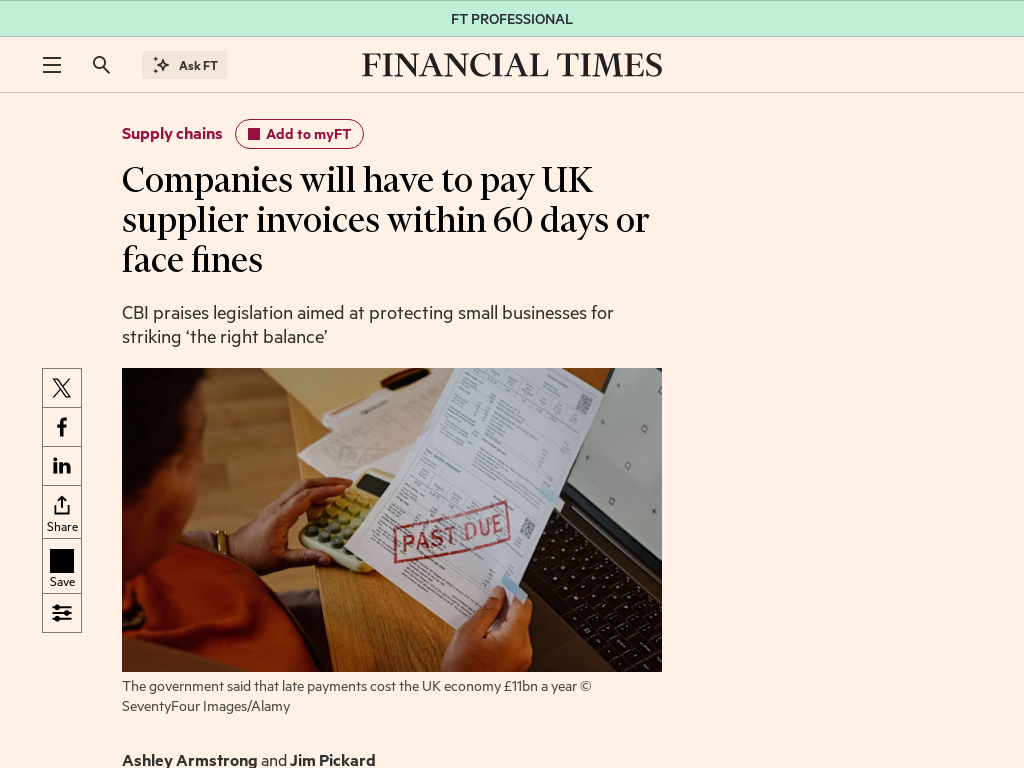
Companies will have to pay UK supplier invoices within 60 days or face fines

ctrlbrk

Free Member
May 13, 2021
1,004
407
Just seen this in the news:

Companies that fail to pay suppliers within 60 days will face fines or automatic interest payments, as the government prepares to unveil new rules on Tuesday designed to protect small businesses.

Previously, invoices were supposed to be paid within that timeframe as part of an existing Prompt Payment Code, but upcoming legislation will make meeting the deadline mandatory.

Boards will also be required to include their payment terms in their audit reports and lay out steps on how they will improve performance.

The legislation is expected to be in the King’s Speech in May, which will set out the government’s legislative agenda for the following year.


I've seen various initiatives and regulation of this type over the years - and not a huge amount of change in actual payment terms from the 'usual suspects' - the majority being in construction and big retail.

Many years ago, the FSB ran a 'hall of shame' for bad payers - most of whom exceeded 120 day terms. It was quite revealing!

I'd love to see a culture of prompt/reliable payment (it may upset @Ian J though), maybe this will be the start?
 
Upvote 0

lmkeller14

Free Member
Business Listing
Feb 25, 2026
14
4
Edinburgh, Scotland
Just seen this in the news:

Companies that fail to pay suppliers within 60 days will face fines or automatic interest payments, as the government prepares to unveil new rules on Tuesday designed to protect small businesses.

Previously, invoices were supposed to be paid within that timeframe as part of an existing Prompt Payment Code, but upcoming legislation will make meeting the deadline mandatory.

Boards will also be required to include their payment terms in their audit reports and lay out steps on how they will improve performance.

The legislation is expected to be in the King’s Speech in May, which will set out the government’s legislative agenda for the following year.
About time honestly, the Prompt Payment Code was always toothless because there was no real consequence for ignoring it, so making it mandatory with actual financial penalties is the kind of thing that might finally shift the culture around how big companies treat their suppliers.
 
Upvote 0

Ozzy

Founder of UKBF
UKBF Staff
  • Feb 9, 2003
    8,330
    11
    3,459
    Northampton, UK
    bdgroup.co.uk
    Many years ago a supplied had a statement on their invoices that read something along the lines of;

    "Please pay this invoice on promptly, so that I may pay them promptly, so they may pay you promptly."


    I liked that. I have been a subscriber to the Better Payment code of practice for many years, proudly, and was something that really paid dividends when my financial controller passed away in 2007 and it took me a couple months get the accounts back up to speed - all our suppliers were exceptionally understanding, quoting we know you're good for it, take your time.
     
    Upvote 0
    I'd love to see a culture of prompt/reliable payment (it may upset @Ian J though), maybe this will be the start?

    I can't see it working as too many larger companies wouldn't be able to afford to do it and many of them actually have 90 days payment terms in their conditions of purchase.

    Knowing this lot they will bring in the law and after a few months it will be their umpteenth U turn
     
    Upvote 0

    Chris Ashdown

    Free Member
  • Dec 7, 2003
    13,379
    3,002
    Norfolk
    I can't see it working as too many larger companies wouldn't be able to afford to do it and many of them actually have 90 days payment terms in their conditions of purchase.

    Knowing this lot they will bring in the law and after a few months it will be their umpteenth U turn
    Ian, I doubt that big companies will be able to ignore it and also have to change their T&C's. Just take a big hit for a quarter especially companies like Shell
     
    Upvote 0

    Tables Force

    Free Member
    Aug 23, 2023
    125
    56
    The 60 day payment is only one part of what they've announced today.

    Amongst other things:
    • The Small Business Commissioner (SBC) will investigate businesses suspected of poor payment practices.
    • The SBC will have the power to fine businesses, including significant potential fines for large companies that persistently pay their suppliers late.
    • Large companies, that are persistently late payers, will have to publish commentary on why payment performance is poor and what actions they are taking to fix this.
    • A statutory time limit for disputing supplier invoices (think the current proposal is 30 days).
    • Mandatory interest on late payments, with no opt-out - with large companies required to report on this in their annual accounts

     
    Upvote 0

    SillyBill

    Free Member
    Dec 11, 2019
    816
    2
    525
    IME most big businesses do at least pay lip service to the law, codes of practice (as now) can be totally ignored.

    So I personally welcome this, do I think it will be wholesale change to the payment landscape? No... but it will mean 60 is the most big business can ask for upfront in contracts and I see that as welcome move. If that helps a few companies get paid in c. 65-70 days (when the intial 60 day deadline is invariably ignored) vs 95-100 days then it will have moved the needle positively. Noone is likely expecting this will knock 30+ days off average debtor days; even if it knocks 5 days off the current status quo that can be transformational for many SMEs. Thats a few billion sloshing around the economy again.

    If it means some big corporates have to spend more time massaging their own data to pretend they're paying up on time...also good, create a load more admin/reputational risk for them in order for them to continue "as is". IME "faking" data tends to take a lot more time than when it is reported it faithfully. I am usually here to criticise government but this is one where I welcome the law actually being behind us, if a big company wants to break the law, then that is up to them.
     
    • Like
    Reactions: ctrlbrk
    Upvote 0

    Data Swami

    Business Member
  • Business Listing
    Having worked with large corporates gotta say this is a good one. Spent months chasing a investment bank having to go through about 15 different layers of "accounts" team members and having to prove what work was done just to get a 30 day piece of work paid
     
    Upvote 0

    Justin Smith

    Free Member
    Jun 6, 2012
    2,744
    398
    Sheffield
    This may be unpopular on here but I do not agree with it at all. We live in an overregulated society and I do not see how the relationship between a buyer and a supplier is anything to do with the government (just like I do not see how the relationship between an employer and his employees is anything to do with the government either).
    No supplier has to deal with any buyer, as an example we stopped dealing with Siemens (on an invoice basis anyway) because they took too long to pay.
    If a customer takes too long to pay then the solution is obvious : don't deal with them (on an invoice basis) again, from now on it's cash up front....
     
    Upvote 0

    JEREMY HAWKE

    Business Member
  • Business Listing
    Mar 4, 2008
    8,587
    1
    4,034
    EXETER DEVON
    www.jeremyhawkecourier.co.uk
    And how many suppliers are going to threaten their customers with fines (or whatever) ?
    I'm sorry Justin you have ignored what happens in real life business relationships with larger companies
    I never said anything about any fines its just much easier for these companies to favour suppliers that dont rock the boat and buy into their preferred terms of business
     
    Upvote 0

    Newchodge

    Moderator
  • Business Listing
    Nov 8, 2012
    22,674
    8
    7,985
    Newcastle
    This may be unpopular on here but I do not agree with it at all. We live in an overregulated society and I do not see how the relationship between a buyer and a supplier is anything to do with the government (just like I do not see how the relationship between an employer and his employees is anything to do with the government either).
    No supplier has to deal with any buyer, as an example we stopped dealing with Siemens (on an invoice basis anyway) because they took too long to pay.
    If a customer takes too long to pay then the solution is obvious : don't deal with them (on an invoice basis) again, from now on it's cash up front....
    You don't understand the issue of power imbalance and those with power exploiting those without?
     
    • Like
    Reactions: YasmeenLondon
    Upvote 0

    Paul Carmen

    Business Member
    Business Listing
    Jan 27, 2018
    870
    1
    427
    Newport Pagnell
    insiteweb.co.uk
    This may be unpopular on here but I do not agree with it at all. We live in an overregulated society and I do not see how the relationship between a buyer and a supplier is anything to do with the government (just like I do not see how the relationship between an employer and his employees is anything to do with the government either).
    No supplier has to deal with any buyer, as an example we stopped dealing with Siemens (on an invoice basis anyway) because they took too long to pay.
    If a customer takes too long to pay then the solution is obvious : don't deal with them (on an invoice basis) again, from now on it's cash up front....
    Unfortunately, this is very myopic and blinkered. Sorry to be blunt, you may be lucky and are able to pick and choose, plus have a big enough supplier and cash base to be able to drop one who's awkward, many are not in that position.

    Having been on both sides of the fence, running my own SME, but previously having held senior roles for a national retailer, I've seen how difficult it can be.

    Many of the major retailers have outrageously long payment terms, and if you don't like it you can't get listings. This in itself can bankrupt start ups and smaller companies as cash flow is often a major issue, as all the big retailers behave in this way, you can't simply drop one.

    I've seen a successful former client of ours shut because the industry they worked in structured contracts so that all the smaller companies take the risks, and if a few major projects go wrong all the sub contractors get shafted.

    Not everyone is selling products, many sell services, software etc too. In the past we've had clients who decided unilaterally they don't want to adhere to contract terms. We have robust agreements in place, so can enforce this if needed, but it would be much easier to not have to take people to court if they don't pay invoices.

    Regulation is needed in all spheres of life and work, as otherwise the strong take advantage of the weak, often not caring if they bankrupt others. Without employee regulation people would be paid a pittance in many industries, fired without recourse etc.

    The UK has polluted rivers and seas, factory farming torturing animals, people being fired and rehired, a zero hours contracts underclass, energy companies profiteering, yet you talk about an overregulated society. I strongly suspect you are a believer in the trickle down economy!!!
     
    Upvote 0

    Justin Smith

    Free Member
    Jun 6, 2012
    2,744
    398
    Sheffield
    Without employee regulation people would be paid a pittance in many industries, fired without recourse etc.
    I don't agree with you. It is the free market and the fact employees can move jobs which is the driver of pay and conditions. It works both ways. I can remember after the Covid madness when there was a mssive shortage of HGV drivers and companies were trying to poach them off each other by offering massive pay packets and signing on bonusses. If you think the government should set minimum wages (and I do not *) do you also think they should set maximum wages as well ? And if not why not ?

    * When the minimum wage was introduced in 1999 it was £3.60 per hr, adjusted for inflation in 2025 that would be £6.80, but it's actually £12.21, which is is 80% higher. It is now DEFINITELY too high, it is the 2nd highest in the world (excl Luxembourg and Iceland). Without any doubt is affecting the employability of many people particularly the young.
    The minimum wage has effects far beyond those actually on it as has consequences on differentials, it either puts up the pay of those on more than the minimum wage or it lowers the incentive to bother getting a better job (with the probable increase in responsibility etc). But "progressives" love it as it salves their social consciences, even more so as they aren't the ones having to pay it.
     
    Upvote 0

    Newchodge

    Moderator
  • Business Listing
    Nov 8, 2012
    22,674
    8
    7,985
    Newcastle
    Employees have plenty of power, they can leave an get a job elsewhere, and that is why employers pay their (good) staff as much as they can and treat them as well as they can.
    Don't talk rubbish. Have you seen the unemployment figures?
     
    Upvote 0

    Justin Smith

    Free Member
    Jun 6, 2012
    2,744
    398
    Sheffield
    Regulation is needed in all spheres of life and work
    We live in a hugely over regulated society and it is getting worse every year, as they are adding to it every year but when did they ever get rid of a regulation ?!? Almost never.
    There are any number of ludicrous regulations but the prize for the most ludicrous goes to :
    Martin's law* : which requires all public venues to have plans for what to do in the event of a terrorist attack... As of today Google gave 23 deaths in 50 years, 22 in Manchester in 2017 and 1 at the Olympia in London in 1976. So all that regulation and cost to save less than one life every two years, though in fact it'd be less than that anyway because that regulation would not necessarily stop any attack, though it might just mitigate it. So let's go for halving the risk thus saving about 1 life every five years. To put that into context on average about 7500 people would get killed on the roads in five years and over 3 million people die of all causes.
    TBH I wouldn't do anything about a risk that was so small it only killed one person every five years, it's cobblers.

    * most laws or regulations that have a name attached to them are more about virtue signalling than actually achieving anything, particularly anything proportionate : cost v benefit wise
     
    Upvote 0

    Justin Smith

    Free Member
    Jun 6, 2012
    2,744
    398
    Sheffield
    Don't talk rubbish. Have you seen the unemployment figures?
    Exactly ! That fall off in employment is to a large extent caused by the Labour Government interfering in the market and taxing employment.....
    These days employers are forced to pay people more than they think they're worth (particularly young people) and, even worse, thanks to the - not needed - new workers rights bill, it's harder to get rid of unsuitable employees. Anyone who is surprised that employment has nose dived cannot have two brain cells to rub together....
     
    Upvote 0

    Paul Carmen

    Business Member
    Business Listing
    Jan 27, 2018
    870
    1
    427
    Newport Pagnell
    insiteweb.co.uk
    I don't agree with you. It is the free market and the fact employees can move jobs which is the driver of pay and conditions. It works both ways. I can remember after the Covid madness when there was a mssive shortage of HGV drivers and companies were trying to poach them off each other by offering massive pay packets and signing on bonusses. If you think the government should set minimum wages (and I do not *) do you also think they should set maximum wages as well ? And if not why not ?

    * When the minimum wage was introduced in 1999 it was £3.60 per hr, adjusted for inflation in 2025 that would be £6.80, but it's actually £12.21, which is is 80% higher. It is now DEFINITELY too high, it is the 2nd highest in the world (excl Luxembourg and Iceland). Without any doubt is affecting the employability of many people particularly the young.
    The minimum wage has effects far beyond those actually on it as has consequences on differentials, it either puts up the pay of those on more than the minimum wage or it lowers the incentive to bother getting a better job (with the probable increase in responsibility etc). But "progressives" love it as it salves their social consciences, even more so as they aren't the ones having to pay it.
    This is the usual old dog whistle and straw man tired arguments. You can't even live on the minimum wage in the UK.

    As for employees having any strength; those zero hours employees have so many rights, but they walk into a job city trading if they are fired in your world...

    As soon as anything happens (or not, witness Ai) companies shed a huge number of people as an excuse for cost cutting, while bosses get paid vastly more as an order of magnitude than the minimum wage increase.

    One thing we probably agree on is UK PLC is tired and not working very well, but this 14 years of austerity and deregulate everything Tory/Reform crap you're proposing wont fix any of it. It's a route to the bottom and the strong punishing the weak as we see from Trump in the USA.

    As we're not going to agree, I suggest we leave the thread to invoice discussions, as I really don't want to (and I doubt Ozzy wants to) get involved in another Covid crackpot thread part 2 with you...
     
    Upvote 0

    DontAsk

    Free Member
    Jan 7, 2015
    5,456
    3
    1,394
    that is why employers pay their (good) staff as much as they can
    Which is the same as saying they pay them as little as they can get away with, without losing them. No or vert few employers pays staff as much as they could. Doing so would just reduce profit to zero.

    and treat them as well as they can.
    Which is the same as treating them as badly as they can get aways with. Treating them as well as they could (e.g., healthcare, better pensions, ...) would again reduce profit to zero.

    There are a few exceptions but not may and not outstanding.
     
    Upvote 0

    Justin Smith

    Free Member
    Jun 6, 2012
    2,744
    398
    Sheffield
    Which is the same as saying they pay them as little as they can get away with, without losing them. No or vert few employers pays staff as much as they could. Doing so would just reduce profit to zero.


    Which is the same as treating them as badly as they can get aways with. Treating them as well as they could (e.g., healthcare, better pensions, ...) would again reduce profit to zero.

    There are a few exceptions but not may and not outstanding.
    Not sure what point you are making here. When I say employers pay their good employees as much as they can that obviously means consistent with making a profit or the business would go bust. Unless, of course, you are implying the business should pay everone (incl the owner) the same rate. I believe the latter has been tried before ? :

    Man walks into a car showroom back in 1983 Russia. He is impressed with the Lada on sale there, I like it he says I will have it, when can you deliver it ?
    The sales man checks up and replies it'll be on the 13th June 1985, do you want it in the morning or the afternoon ?
    It'll have to be the afternoon as I have a washing machine coming in the morning
     
    Upvote 0

    Justin Smith

    Free Member
    Jun 6, 2012
    2,744
    398
    Sheffield
    You can't even live on the minimum wage in the UK.
    The facts :
    The UK minimum wage is the 2nd highest in the world (excl Iceland and Luxembourg).

    My first job in 1985 was as an assistant manager in a Hire Shop on £5,500 p.a. = £2.64 per hr. As at Apr 25, inflation adjusted, that equals £8.02 per hour.
    The minimum wage for 2025 was £12.21 an hour which is 52% higher then my starting wage as an assistant manager !

    When the minimum wage was introduced in 1999 it was £3.60 per hr, adjusted for inflation in 2025 that would be £6.80, but it's actually £12.21, which is is 80% higher.
     
    Upvote 0

    Paul Carmen

    Business Member
    Business Listing
    Jan 27, 2018
    870
    1
    427
    Newport Pagnell
    insiteweb.co.uk
    The facts :
    The UK minimum wage is the 2nd highest in the world (excl Iceland and Luxembourg).

    My first job in 1985 was as an assistant manager in a Hire Shop on £5,500 p.a. = £2.64 per hr. As at Apr 25, inflation adjusted, that equals £8.02 per hour.
    The minimum wage for 2025 was £12.21 an hour which is 52% higher then my starting wage as an assistant manager !

    When the minimum wage was introduced in 1999 it was £3.60 per hr, adjusted for inflation in 2025 that would be £6.80, but it's actually £12.21, which is is 80% higher.
    You cannot live in the UK on those wages; e.g. house prices have risen circa x10 since the mid 80s, so you'd need to be on £26.40 per hour for an equivalent income to yours in 1985.

    Rent differences are staggering, a London council house rent was about £65 a month in the mid 80s. You largely can't get council houses now, but the average private rent in London is £2,000+ a month, or £1,300 UK average.

    To rent a room in London is £1,000 a month, so you can't afford to rent in London on minimum wage, let alone eat or heat your home, in much of the rest of the country it's not very different.

    You've cherry picked facts to make your straw man argument stand up, they don't, please stop posting rubbish.
     
    Upvote 0

    DWS

    Free Member
    Oct 26, 2018
    1,667
    4
    572
    Bridgend, South Wales
    You cannot live in the UK on those wages; e.g. house prices have risen circa x10 since the mid 80s, so you'd need to be on £26.40 per hour for an equivalent income to yours in 1985.

    Rent differences are staggering, a London council house rent was about £65 a month in the mid 80s. You largely can't get council houses now, but the average private rent in London is £2,000+ a month, or £1,300 UK average.

    To rent a room in London is £1,000 a month, so you can't afford to rent in London on minimum wage, let alone eat or heat your home, in much of the rest of the country it's not very different.

    You've cherry picked facts to make your straw man argument stand up, they don't, please stop posting rubbish.
    But then not all employers can keep affording to pay employees those amounts along with the ER N/I increases, you have small businesses who have to continually put up their prices and ultimately it’s the consumer who has to pay extra and then looks to go elsewhere.
    It has started already from looking and speaking to my clients, small businesses will not take on employees as it is too expensive and a cost that cannot be passed on, so it will come down to that they either carry on as they are with no growth or they just have self employed workers!
     
    Upvote 0

    DontAsk

    Free Member
    Jan 7, 2015
    5,456
    3
    1,394
    I fail to see the logic.

    But then not all employers can keep affording to pay employees those amounts along with the ER N/I increases, you have small businesses who have to continually put up their prices and ultimately it’s the consumer who has to pay extra and then looks to go elsewhere.
    Elsewhere are also suffering the same. A good business will succeed by not competing only on price.

    It has started already from looking and speaking to my clients, small businesses will not take on employees as it is too expensive and a cost that cannot be passed on, so it will come down to that they either carry on as they are with no growth or they just have self employed workers!

    If there's real, sustainable, growth to be had then the business can afford a part time (at least to start with) employee. Costs are covered by the business growth, not simply pased on.
     
    • Like
    Reactions: ctrlbrk
    Upvote 0

    DWS

    Free Member
    Oct 26, 2018
    1,667
    4
    572
    Bridgend, South Wales
    I fail to see the logic.


    Elsewhere are also suffering the same. A good business will succeed by not competing only on price.


    If there's real, sustainable, growth to be had then the business can afford a part time (at least to start with) employee. Costs are covered by the business growth, not simply pased on.
    I can not help your failure to see the logic, I can only comment on the businesses that I have as clients, businesses are no longer willing to take on Employees for all the added costs that come with them, it is a safer option to just get outside labour in when required rather than having the constant expense of an employee.
     
    Upvote 0

    MikeJ

    Free Member
    Jan 15, 2008
    6,953
    2,248
    Northumbeland
    The facts :
    The UK minimum wage is the 2nd highest in the world (excl Iceland and Luxembourg).

    My first job in 1985 was as an assistant manager in a Hire Shop on £5,500 p.a. = £2.64 per hr. As at Apr 25, inflation adjusted, that equals £8.02 per hour.
    The minimum wage for 2025 was £12.21 an hour which is 52% higher then my starting wage as an assistant manager !

    When the minimum wage was introduced in 1999 it was £3.60 per hr, adjusted for inflation in 2025 that would be £6.80, but it's actually £12.21, which is is 80% higher.

    So fourth then ...:rolleyes:
     
    • Like
    Reactions: Paul Carmen
    Upvote 0

    Paul Carmen

    Business Member
    Business Listing
    Jan 27, 2018
    870
    1
    427
    Newport Pagnell
    insiteweb.co.uk
    But then not all employers can keep affording to pay employees those amounts along with the ER N/I increases, you have small businesses who have to continually put up their prices and ultimately it’s the consumer who has to pay extra and then looks to go elsewhere.
    It has started already from looking and speaking to my clients, small businesses will not take on employees as it is too expensive and a cost that cannot be passed on, so it will come down to that they either carry on as they are with no growth or they just have self employed workers!
    I agree, but that's not down to lack of regulation, nor is hollowing out public services, removing employee safeguards or the minimum wage, they are symptoms not answers.

    We have a structural issue, one that didn't really exist in the 1980s, as Thatcher and Reagan had just started their deregulate and sell off everything mission. This reversed or eroded a lot of the post depression/WW2 New Deal/NHS type policies, that made life for everyday citizens better.

    40 years later, the market first and wealth will trickle down political movement has left the UK state/public owning virtually nothing. Multi national corporations make a fortune and usually pay very little or no UK tax, filtering funds through other countries via fees, and profiteering when they can.

    Since the start of the 1980s we have had huge changes in CEO and company board earnings. Compared to average employees wage, CEOs are somewhere around 300 to 1 now, up from around 30 to 1 back then, essentially paying rubbish real world wages, while earning many millions themselves.

    Then there's the huge surge in multi millionaires and billionaires, who can move country to avoid paying personal and property taxes. We have the double whammy of companies moving their workforce out of the UK since Brexit, with many of these people being strong advocates for leaving the EU!

    There's money sloshing around everywhere, more of it than ever before, with quantitative easing having pumped out money, lowered interest rates and made it easier to borrow, yet we are poorer individually and as a nation.

    It's largely because this money makes money, with a big increase in share buy backs inflating stock market values and making investors more money. Venture capitalist companies back disruptors, Ai startups etc, who often strip margin and jobs out of entire sectors. There's a famous giant online retailer who took 15 years to start making a consistent (and now huge) profit, yet it grew and grew selling at wafer thin margins. Margins in entire sectors collapsing put large and small profitable retailers, that employed thousands, out of business.

    The biggest con job of the entire project is that the mainstream media and right of centre governments, backed by the wealthy, have convinced the likes of Justin, that there's too much regulation and the little guy earns too much money! There's another deregulate and slash services party that appeals to a certain demographic. They, along with the same media giants, blame immigrants, or people of a different colour. While the same companies heat the planet, reduce their worforces and wages, all to make ever larger profits...

    We have a real problem, and it's not going to be solved by tinkering around the edges, certainly not in the UK. Adding cost at the lowest end for employees is simply making it worse, as are things like sales taxes. There is virtually no trickle down economy, with the richest individuals and biggest companies hoarding their money and effectively taking it out circulation.

    We need to wake up and stop falling for divide and conquer tactics. Something drastic needs to change to reverse this process, or healthcare and public services will continue to get worse as the population ages and they become ever more costly.
     
    • Like
    Reactions: Newchodge
    Upvote 0

    Paul Carmen

    Business Member
    Business Listing
    Jan 27, 2018
    870
    1
    427
    Newport Pagnell
    insiteweb.co.uk
    So the Bank of England's inflation calculator is "rubbish" is it ?
    If you're using the BoE website calculator, it uses the Consumer Price Index (CPI), a basket of goods looking at the change in purchase prices of these goods (in a weighted basket).

    You'd have to factor in any housing costs separately to CPI. This means it is "rubbish" for the real long term cost of living metrics versus wages we are talking about.

    The Consumer Price Index including Owner Occupiers’ Housing Costs (CPIH), factors in an adjusted monthly "rent" equivalence figure. This inflation rate is quite a bit higher (every month) than the CPI, this adds significantly to real living costs.

    Even the CPIH doesn't really reflect all true living cost changes; there are a few reasons for this, the basket of goods has changed a lot over time, plus it doesn't cover a large proportion of people in the UK being home owners. House buying and mortgage costs are considered a capital cost (even for private home owners) so not included. There is the old RPI data set which does include mortgages, this inflation rate is even higher again, having gone up 400% since the late 80s.

    When you factor in the lack of affordable/council houses today, recent big increases in food and energy costs, plus use the right data sets for your calculations, you can see that wages have stagnated in real terms for a long time.

    For those at the bottom end pay wise it's way worse, with their real earnings and disposable income going down over that period, and even more dramatically over the periods of successive Tory governments. Getting on the housing ladder is a pipe dream for many in low paid work, with benefits and food banks a reality even when they're working full time.

    All your examples stated as facts, or in bold/capitals, are not "facts" they're opinions. This is common behaviour among people who don't use complex data to make an argument. The simplistic views and straw man arguments you've made don't stand up to scrutiny. If you think you can live on the minimum wage in most of the UK, why don't you give it a try and report back on your findings.
     
    Last edited by a moderator:
    • Like
    Reactions: fisicx
    Upvote 0

    Latest Articles